
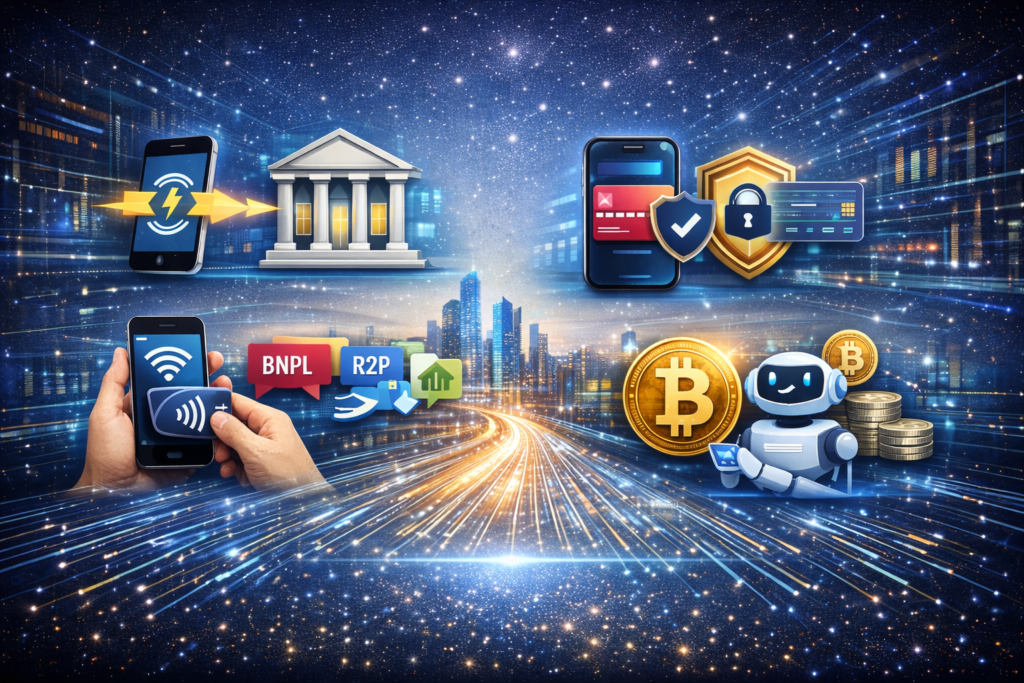
The acquiring landscape is undergoing rapid transformation, driven by evolving consumer payment preferences, regulatory changes, and technological advancements. Today, acquiring is no longer just about enabling merchants to accept card payments; it encompasses a broader ecosystem of digital wallets, real-time payments, alternative payment methods, and embedded finance solutions. Acquirers are adapting their platforms to support seamless omnichannel experiences, enhance fraud prevention, reduce settlement times, and deliver value-added services such as data-driven insights and flexible financing. These trends are reshaping how payments are initiated, authorized, processed, and how merchants ultimately receive funds, setting the stage for a more dynamic and competitive acquiring market.
Let’s look at some of the key trends that are redefining the acquiring landscape and shaping the future of how merchants accept and get paid.
Real-time Payment & Settlement
Merchants today expect faster access to their funds to keep supply chains moving smoothly and to improve working capital management. Traditional acquiring models often involve settlement delays of one to three days, creating cash flow challenges, particularly for small and medium-sized businesses. Real-time payment and settlement capabilities—enabled by faster payment infrastructures such as UPI (India), RTP (U.S.), FedNow (U.S.), and SEPA Instant (Europe)—are emerging as a key differentiator. By integrating with these rails, acquirers can enable merchants to receive funds almost instantly after a transaction is approved. This reduces liquidity pressure, strengthens merchant trust, and positions real-time settlement as a critical trend in the evolving acquiring ecosystem.
Tokenization and Secure Payments
Merchants are increasingly adopting solutions to avoid handling raw cardholder data, thereby reducing the scope of Payment Card Industry Data Security Standard (PCI DSS) compliance and mitigating security risks. Tokenization replaces sensitive card data, such as the Primary Account Number (PAN), with unique, non-sensitive tokens that can be securely stored and used for transactions without exposing actual cardholder details.
Digital wallets, such as Apple Pay, Google Pay, and Samsung Pay, utilize tokenization in conjunction with Near Field Communication (NFC)-based tap-to-pay technology to provide enhanced security and user convenience. Similarly, Click to Pay, introduced by major card networks (Visa, Mastercard, American Express, and Discover) in 2019 as a standardized, tokenized checkout solution under the Secure Remote Commerce (SRC) framework, is seeing growing adoption among merchants and issuers.
Additionally, Apple Pay has expanded its accessibility: previously limited to the iPhone and Safari browser on Mac, it now supports all major browsers starting with iOS 18 (2024), significantly broadening usability. Beyond wallets, network tokenization is expanding into e-commerce and recurring billing, replacing sensitive PANs in card-on-file and subscription use cases. These advancements highlight the pivotal role of tokenization and digital wallet-based payments in simplifying PCI DSS compliance while enhancing secure and seamless customer experiences.
Alternative and Additional Payment Methods
Beyond cards and digital wallets, a wave of new payment options is reshaping the acquiring landscape. Solutions such as Request to Pay (R2P) provide customers with greater flexibility and control by allowing them to authorize payments on demand, while merchants benefit from lower costs and improved reconciliation.
At the same time, Buy Now, Pay Later (BNPL) offerings continue to gain traction, especially in e-commerce, by enabling consumers to split purchases into installments with little or no interest. These models appeal to younger demographics and those seeking credit alternatives, making them an increasingly important acceptance requirement for merchants.
Open Banking–based payments are also gaining momentum in markets with supportive regulation. These enable account-to-account transfers that bypass card networks, reducing payment costs for merchants while providing consumers with secure, frictionless checkout experiences.
In addition, smartphones themselves are becoming payment acceptance devices, with Apple’s Tap to Pay on iPhone and similar Android-based solutions turning mobile phones into fully functional POS terminals. Supported by major card networks, this innovation eliminates the need for dedicated card readers, lowers the cost of acceptance, and opens up new opportunities for micro-merchants and gig-economy workers to accept contactless payments anywhere.
Emergence of Crypto Payments
Cryptocurrency is steadily evolving from a niche investment asset into a potential method of payment within the acquiring ecosystem. Merchants are beginning to accept crypto directly or through processors that instantly convert digital currencies into fiat, reducing volatility risk. Stablecoins, in particular, are gaining traction as they offer faster cross-border settlement and lower transaction costs compared to traditional methods.
While consumer adoption remains uneven and regulatory frameworks are still maturing, major card networks and processors are experimenting with crypto acceptance, custody, and settlement capabilities. For acquirers, enabling crypto payments—whether for retail transactions, cross-border commerce, or digital-native businesses—represents both an opportunity to attract new customer segments and a challenge in managing compliance, volatility, and security. Ultimately, regulatory clarity and consumer trust will determine how widely crypto payments are integrated into mainstream acquiring.
Generative AI and Conversational Payments
Since the introduction of ChatGPT and other large language models (LLMs), Generative AI has become a transformative force across industries, and payments are no exception. One of the most promising developments is the Model Context Protocol (MCP)—an emerging standard that allows acquirers and payment providers to expose secure services, such as initiating and processing payments, through AI-driven interfaces.
By deploying MCP servers, acquirers can enable merchants and PSPs to integrate conversational payment flows, where customers interact through chat interfaces to browse products, receive recommendations, and complete transactions seamlessly within the same channel. This paves the way for a new era of conversational commerce, where shopping and payments converge in natural, AI-powered interactions.
While still in early stages, as this trend matures we can expect merchants to increasingly embed payments into messaging platforms, virtual assistants, and AI-driven storefronts, redefining customer engagement and the acquiring value chain. Please read our article on MCP and how it works here