
Sustainability is no longer just a social concern; it has become a strategic priority across industries worldwide. For the payments ecosystem, this means recognizing the responsibility to safeguard the planet for future generations. If current consumption and environmental practices continue unchecked, we may face significant challenges in maintaining a livable planet within the coming decades.
Carbon credits are often positioned as a mechanism for organizations to offset their environmental impact, but they can sometimes be perceived as a way to sidestep direct responsibility for sustainable practices. A carbon credit represents a permit that allows the holder to emit a certain amount of carbon dioxide or equivalent greenhouse gases, with the intent that these emissions are balanced by reductions elsewhere, such as reforestation or renewable energy projects. While carbon credits can play a role in the transition toward sustainability, they bring challenges in transparency, measurement, and tracking. Issues such as double-counting, inconsistent regulatory frameworks, and the lack of standardized reporting make it difficult to ensure that the intended environmental benefits are truly realized. For the payments industry, this highlights the importance of going beyond offsets and embedding sustainability directly into operational models, technology choices, and innovation strategies.
As part of the payments industry, we must work collaboratively with regulators, consumers, and ecosystem players to ensure sustainability is effectively managed. Every stage of the payments lifecycle—across product companies, banks, networks, and service providers—must be evaluated to identify how sustainable practices can be embedded into operations and long-term strategies. This could include reducing the reliance on paper receipts through digital alternatives, optimizing data center operations to lower energy consumption, adopting green cloud infrastructure, promoting digital-first products like virtual cards over plastic card issuance. Such initiatives not only reduce environmental impact but also strengthen consumer trust and align the industry with global sustainability goals.
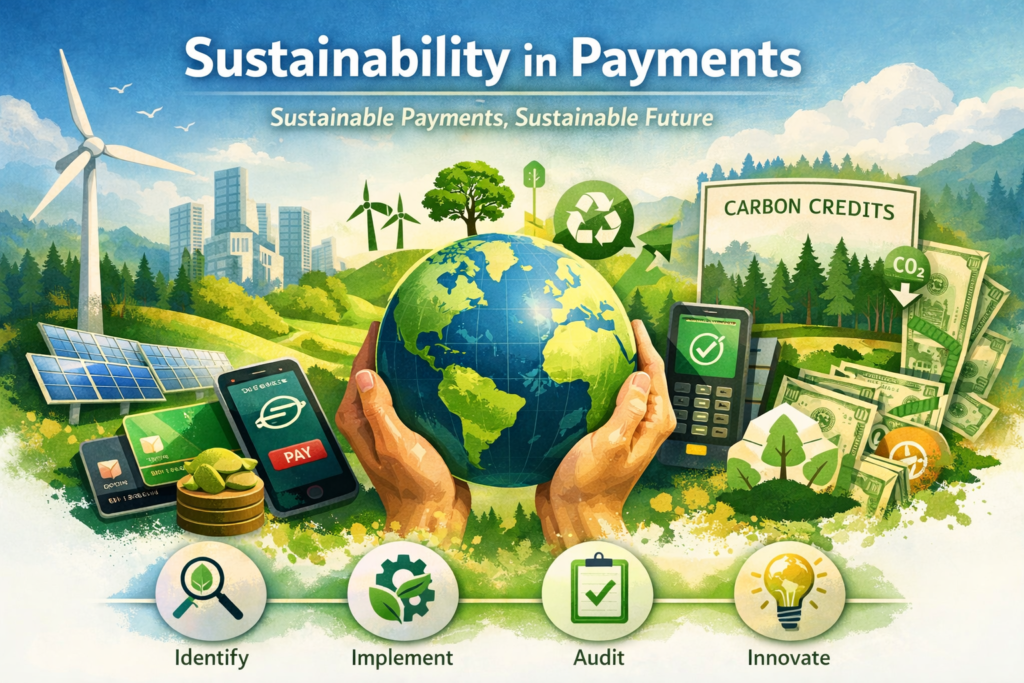
Driving sustainability in payments requires a structured approach. A simple yet effective framework can be outlined in four key steps:
Identify – Assess internal operations, regulatory requirements, and industry trends to pinpoint areas where sustainability can be improved.
Implement – Put in place targeted initiatives—whether process changes, technology upgrades, or policy adjustments—that directly address these areas.
Audit – Establish mechanisms for regular review and auditing to ensure initiatives are being followed, are measurable, and deliver the intended impact.
Innovate – Continuously evolve by adopting modern technologies, new business models, and industry best practices to keep sustainability efforts relevant and future-ready.
By following this cycle, the payments industry can move beyond compliance and drive real, long-term value while setting a benchmark
Finally, it is time for the payments industry to move from intent to action. Rather than relying solely on offsets such as carbon credits, true progress will come from implementing meaningful changes within our own operations and ecosystems. By embracing sustainable practices, aligning with regulatory expectations, and collaborating across the value chain, we can reduce our environmental footprint while driving innovation and trust. The responsibility is collective—let’s work together to embed sustainability at the core of payments and create lasting impact for future generations.
Sustainable payments, sustainable future