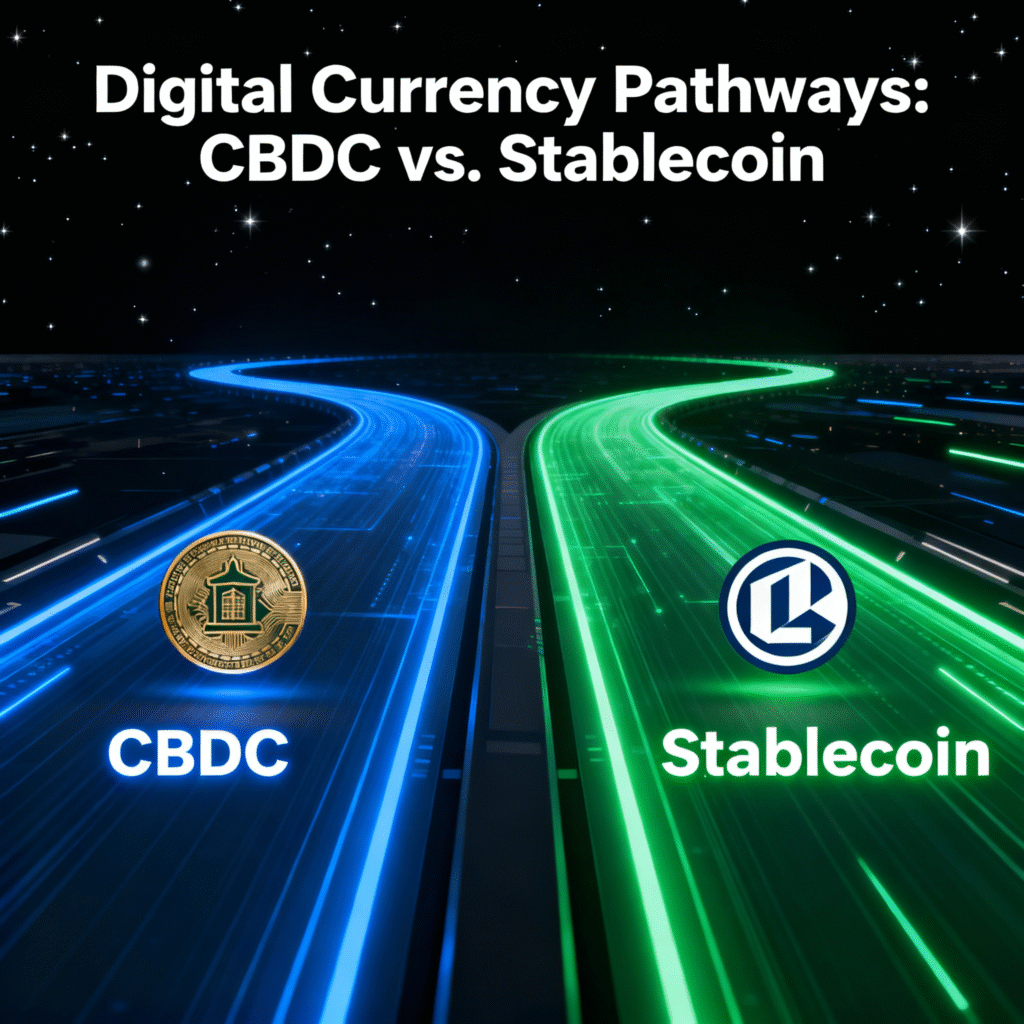
The U.S. has just passed the GENIUS Act in July 2025—short for Guiding and Establishing National Innovation for U.S. Stablecoins. This groundbreaking law officially recognizes stablecoins as financial products and gives them a clear legal and policy framework to operate with confidence. But what does this mean in practice? And how could it affect CBDCs and the wider crypto world? Let’s dive in.
Before we dive in, let’s take a quick look at what CBDCs, cryptocurrencies, and stablecoins actually mean.
Cryptocurrency (Crypto)
Cryptocurrencies are decentralized digital assets built on blockchain technology. Unlike traditional money, they are not controlled by any government or central authority. Popular examples include Bitcoin and Ethereum, which enable peer-to-peer transactions, programmable contracts, and financial innovation—but also come with volatility and regulatory challenges.
Central Bank Digital Currency (CBDC)
A CBDC is a digital form of a nation’s fiat currency, issued and regulated by its central bank. Unlike cryptocurrencies, CBDCs are fully backed by the government, offering trust, stability, and legal tender status. They aim to modernize payments, increase efficiency, and strengthen monetary policy
Stablecoin
A stablecoin is a type of cryptocurrency designed to maintain a stable value, usually by pegging it to a fiat currency like the dollar, pound, or euro or to other assets. They combine the efficiency of crypto transactions with the stability of traditional money, making them useful for payments, remittances,
What’s Happening in the World of Crypto?
The cryptocurrency market, led by Bitcoin and other digital assets, continues to draw global attention. While these cryptocurrencies have seen significant growth and adoption, they remain largely unregulated and highly volatile, with their value driven primarily by market speculation and investor sentiment rather than intrinsic fundamentals. In this article, however, our focus is not on speculative cryptocurrencies. Instead, we will look at Central Bank Digital Currencies (CBDCs) and Stablecoins—two forms of digital money that stand apart because they are either issued directly by central banks or operate under regulatory oversight, aiming to bring stability, trust, and legitimacy to the digital currency landscape.
Let’s take a deeper dive into Central Bank Digital Currencies (CBDCs) and Stablecoins—their growing adoption, and what they truly mean for the future of money.
CBDC – Central Bank Digital Currency
Nearly 90% of central banks worldwide are actively exploring Central Bank Digital Currencies (CBDCs) –
https://www.atlanticcouncil.org/cbdctracker/, with initiatives spread across different stages such as research, proof of concept (PoC), development, and pilot programs. Some of the world’s largest economies—including China, the European Union, and India—are already running pilots to test the viability, scalability, and potential impact of CBDCs on their financial ecosystems. These efforts highlight the global momentum toward digital currencies that are backed by sovereign authority, aiming to enhance payment efficiency, reduce reliance on cash, and strengthen monetary policy implementation.
Stablecoin
Although Stablecoins are cryptocurrencies designed to maintain a stable value—typically by pegging them to a fiat currency or a basket of assets—they have historically been issued and managed by private entities without direct backing from central banks or governments. However, this has begun to change in recent years. Several jurisdictions, including the UAE, South Korea, Japan, and the European Union, have introduced regulatory frameworks for Stablecoins, bringing them under the oversight of central banks and financial authorities. The most recent example is the GENIUS Act in the United States, which formally recognizes Stablecoins as financial products and provides a regulatory framework for their operation. While Stablecoins are still operated by private issuers, they now function within the guardrails of regulation—though the level of oversight varies by country. The underlying principle remains consistent: to ensure stability, trust, and integration with the broader financial system.
At the same time, several countries have either paused their CBDC initiatives (South Korea) or rejected the idea altogether (USA), opting instead to focus on Stablecoins as a more practical path forward. One of the key reasons is the contrast between private and government-led approaches: private issuers of Stablecoins are typically more agile, innovative, and able to bring solutions to market much faster, while governments and central banks often face longer timelines due to regulatory, policy, and infrastructural considerations. For some jurisdictions, this makes Stablecoins—when placed under a clear regulatory framework—a more feasible option to meet the growing demand for digital money without the complexities and risks of rolling out a sovereign CBDC.
The Future
We are seeing a clear divergence in approach across the globe: several major economies continue to pilot and implement CBDCs, while others are leaning toward regulated Stablecoins as their preferred path. In fact, some countries are pursuing both in parallel—exploring CBDCs for sovereign digital money while simultaneously enabling Stablecoins under regulatory oversight to foster innovation and private-sector participation.
This landscape will continue to evolve in the coming years, with both CBDCs and Stablecoins likely to coexist and develop in parallel. As adoption grows, we can expect increasing efforts to establish interoperability between the two, ensuring that digital currencies—whether sovereign-issued or privately managed under regulation—can seamlessly interact within domestic and cross-border payment systems. Such interoperability will be crucial for building a cohesive digital financial ecosystem that balances the stability and trust of government-backed money with the innovation and agility of private sector solutions.
If you have an idea, want to implement it, or simply wish to learn more, feel free to contact us.